

Program Overview
Texarkana College offers an Electrical Technology One-Year Certificate requiring 42 credit hours. The catalog says the certificate commonly takes three semesters. This listing covers that award, not the separate 10-hour Occupational Skills Award or the two-year associate degree. The program page places electrical training on the main campus, building #12 on the campus map, at 2500 North Robison Road in Texarkana, Texas.
The program page describes face-to-face delivery with full-time, part-time, day, and night options, while the certificate catalog page labels the schedule hybrid and says day or night classes may vary by semester.
Curriculum Highlights
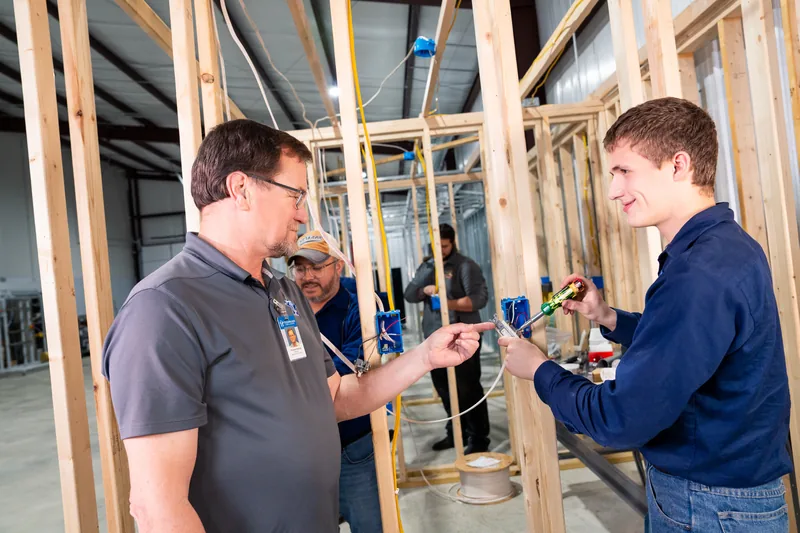
The first two semesters cover the National Electrical Code, DC-AC circuits, electrical safety and tools, electro-mechanical drafting, programmable logic controllers, workforce development, fundamentals of electricity, electrical machines, and residential wiring. The third semester adds fundamentals of electricity II, industrial wiring, electrical troubleshooting, and advanced programmable logic controllers. The program page says students learn to wire, troubleshoot, and repair electrical systems in residential, commercial, and industrial buildings. The shorter Occupational Skills Award contains only three of these courses.
Admission Requirements
Applications are accepted year round. New students choose a program, apply online, receive myTC login credentials, and submit final high school or GED transcripts and any college transcripts. Students under 22 cannot register without proof of a current bacterial meningitis vaccination, though a waiver option is described. Accepted students then apply for financial aid and scholarships and meet an advisor about testing needs, degree plan, and registration. Program questions can go to coordinator Mark Rushing at 903-823-3335.
Cost & Financial Aid
The 2026–27 rates are $99 per credit hour for Bowie County (in-district) residents, $107 plus a $52 per-hour fee for other Texas, Arkansas, and Oklahoma residents, and $116 plus a $102 per-hour fee for non-residents. Flat registration and public-safety fees add $50 per semester, and course fees such as the $25 OSHA-10 test fee may apply. The program page gives an approximate total program cost of $6,855 for full-time in-district students without naming the award. Complete the FAFSA to determine aid eligibility.
Career Outcomes
The catalog says most certificate graduates go directly into the workforce or start their own business, and that electrical skills are useful in many industrial and manufacturing jobs.